
The Story
When I arrived as Acting Headteacher in July 2005 it wasn’t to Ripple Primary School, it was to Ripple Junior School, a 360 pupil, 3 form entry school that was on the same site as Ripple Infant School (which was under separate governance).
As I mentioned previously, Ripple Junior School had spent around 18 months with no consistent leadership due to the Headteacher being very seriously ill. He died in the September after I arrived and it was a real learning curve for me navigating a bereaved school community through their loss of him.
Sadly, a few years later, the infant school Headteacher also became seriously ill and later died. At the point that her ill health meant she had to step down from her role, the LA approached me to cover the infants as Acting Headteacher and the two schools amalgamated a year later to become Ripple Primary School in 2009.
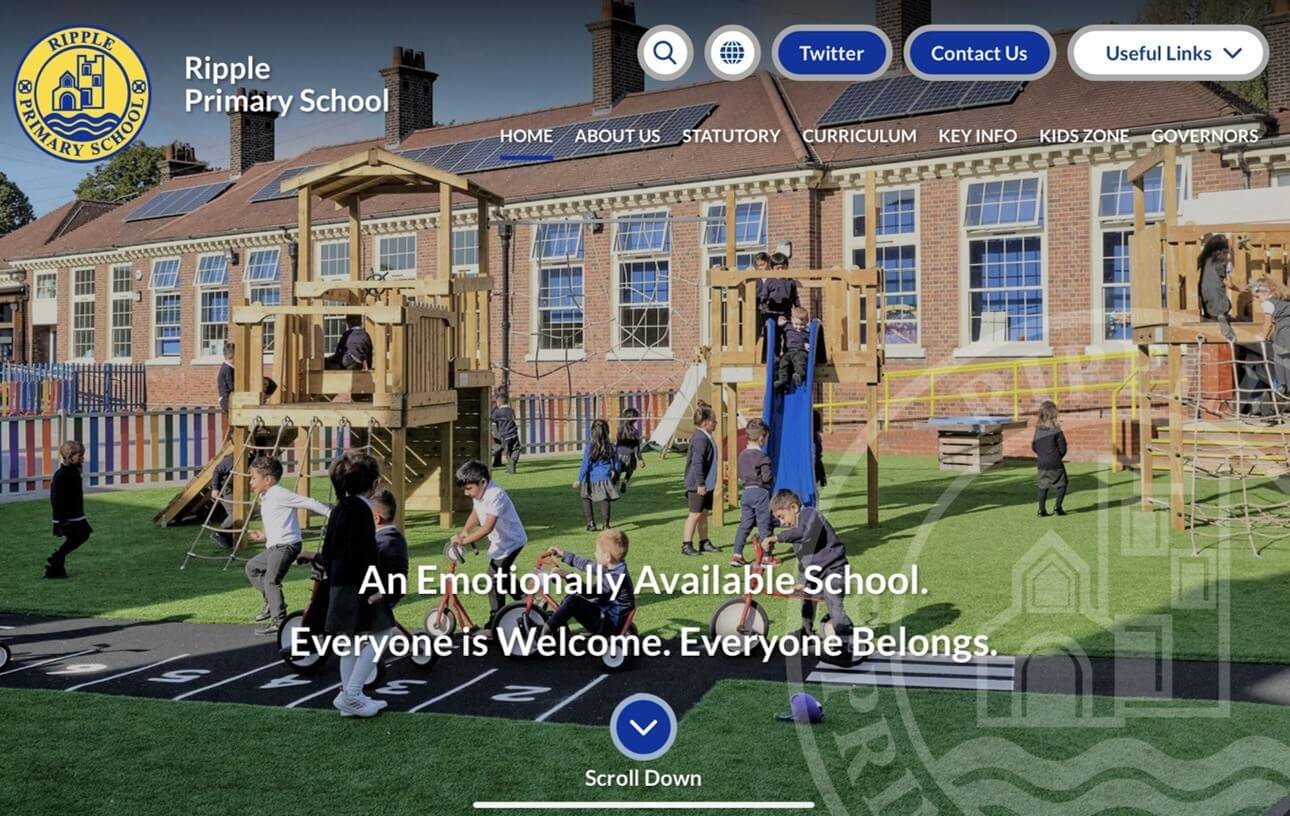
I won’t go into the detail here about what is involved in bringing two schools together; combining two leadership teams/two teaching teams/two support teams/two admin teams/two midday supervisor teams/two Governing Bodies/etc; all bring their own unique challenges – many unforeseeable.
But I will say I quickly realised that I needed to get start straight away in laying the groundwork in preparation for the amalgamation.
Arguably one of the most effective things I did was consult with the whole school community (children, staff, governors, parents and carers, local community leaders and their groups) to lay down the challenge to them of identifying what they wanted our new primary school to look and feel like.
I ended up with a stack of pieces of paper on my desk about two foot high and it took ages to go through it all but, thankfully, they mostly fell into a few common strands that I was able to weave together into a Mission Statement for our new Ripple Primary School:
At Ripple Primary School we are proud to provide a safe, stimulating and inclusive learning environment where every member of our community is valued and respected. We listen to each other and every voice is heard.
Our broad, balanced, creative curriculum and enrichment activities provide opportunities for all to achieve and succeed.
We celebrate our achievements, differences and cultural diversity. Together we take pride in making a positive contribution to our school and the wider community.
The one sentence in all of it that sprang out at me when I was working through it was:
We listen to each other and every voice is heard.
And that has underpinned our collegiate approach to developing our school ever since.
I refer to our Mission Statement frequently as our fundamental point of reference for who we are and what we do. It is highlighted at our welcome meetings with new families. I refer to it when children (and grown-ups) haven’t lived up to our expectations of ‘doing the right thing because it is the right thing to do’.
Most importantly I continually say that this is not who we say want to be.
It is who we say we are.
And if we are not living up to all of those statements at any point then we are not fulfilling our promises to our whole school community.
I also led a lot of staff training in my expectations of how we behave towards each other. Yes it was continuing to embed everywhere our core foundations of Professional Generosity and Professional Maturity but I was trying to refine this further by, for example, extending our sanction free behaviour policy (and the ethos that underpins it) across a whole new set of staff and a whole new age range of children within our new school.
And I also wanted to introduce something that I had discovered from my wife’s social work training some years before and to use it as a vehicle to get everyone to look beyond the actions of the child and to start asking less about the WHATS and more about the WHYS.
The Assessment Framework was introduced to social work practice alongside the key document, “Working Together the Safeguard Children” that was published way back in 1988, the guidance document “Working Together to Safeguard Children” was first published and then revised 1991 in response to the 1989 Children Act, which set out the legislative framework for the current child protection framework system in England and Wales. This was the first of many revisions and updates but that guidance document remains current today.
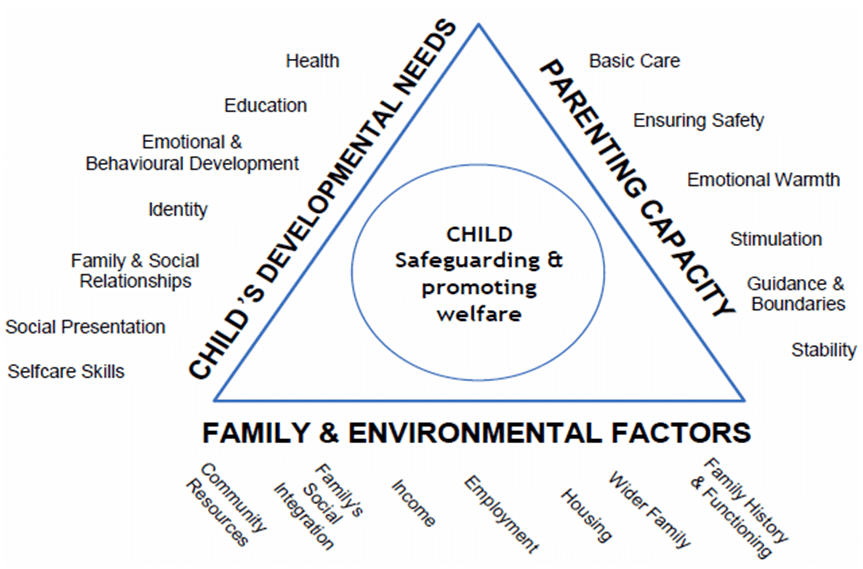
The Assessment Framework is a tool that social workers use for assessing children in need and their families which requires a thorough understanding of children’s developmental needs, the capacity of parents and carers to respond appropriately to these needs, and the impact on that capacity by wider family and environmental factors (physical, social, emotional, economic, etc).
I introduced it to our school in our first INSET as a primary school and have used it over the many years since in our school as a way to challenge attitudes and to ensure that, because all behaviour is communication of a need and not a need in itself, every adult understands the importance of looking beyond the actions of the child and needs to be curious about challenging behaviour in the context of their whole life experience
And the staff came on the journey with me and we reinforced our consensus of how we work with our children and their families.
In terms of the staff team’s development (and please bear in mind that this is a very unrefined description of the process as everyone was at a different starting point with this) the progression, moving clockwise around the triangle from Child’s Developmental Needs, was broadly speaking along these lines:
“That boy/girl needs to sort him/herself out.”
But if he/she could he/she would, but he/she can’t.
to…
“I know why he/she behaves like he/she does. I’ve met his/her parents.”
But why are the parents behaving the way they do? What is their lived experience and how is that impacting on the opportunities they have and the choices they make?
to…
“There is a complex set of circumstance that restrict the choices of the parents, and consequently restrict the choices of the child. No outcome is inevitable, but we need to take a holistic view if we are to best understand the needs of the child and effectively interrupt the trajectory set in motion by their childhood adversities.”
It has been said somewhere (as I recall in some research undertaken many years ago by Shell) that any change, regardless how small, made within any institution will take at least eighteen months to start really embedding and three to five years to become an established part of that institution’s culture. I bear witness to that because it did take a good couple of years for ALL of the staff team to stop talking about “the infants” and “the juniors” and to start just thinking of Ripple Primary School actually being our one school.
But what definitely helped achieve the growing consensus of how we wanted our primary school to be was having these developing views of the child in the context of their family and their family in the context of their environment.
And despite my total lack of awareness at the time that I was doing anything more that trying to “do the right thing because it is the right thing to do”; we had unknowingly introduced and established a secure understanding what would later get refined (by others far more skilled and knowledgeable than us) and labelled as Trauma Informed Practice and the impact of Attachment and Adverse Childhood Experiences.
Around the same time I was HT Rep on the CAAMHS Strategy Board for the LA. One of the big challenges that was highlighted here was the level of drop out and no shows when families were referred to services off site. For example, at that time, uptake of CAAMHS referrals were, at best, around 50%. That experience made me realise that, in supporting your families, the more you can deliver on site at school the better the outcome. Our families are used to being in school and we are able to create a safe and trusting environment that is far more accessible to them that being signposted to somewhere they have never been to see people they don’t know.
So we developed a four strong Social Inclusion Team. Then, with match funding from health, we employed an art therapist and, in doing so, piloted what became the LA’s education and health match funded Primary School Therapy Service that later rolled out across more primary schools in my borough. We engaged with outside partners like Save the Children to deliver the Family And Schools Together programme. We brought in the adult college to deliver EAL, literacy and numeracy courses for our parents. Later we introduced School Nurse drop in sessions and then, with support from one of our local solicitors firms, free legal advice drop in sessions for our families. And so much more.
Then, in 2010, we expanded on to a second site and I was adamant from the very start of that expansion that we would be one school on two sites and that every child would have the same experience in all aspects of school life at Ripple regardless of which site they attended. And, of course, the more that you have established, the more there is to replicate in a different space.
Shell were correct again as it took a good two to three years before everyone even stopped calling the original site the ‘Ripple Site’ and consistently called both sites by their site names of ‘Suffolk Road Site’ and ‘Westbury Site’ as equal parts of Ripple Primary School.
But, with a lot of dedication by the whole team and a lot of hard work, we made it happen and one school on two sites remains a proud feature of our school to this day.
However, sometimes you hit a bump in the road and it throws you sideways a bit. That bump for us was Ofsted in 2014.
More about that in Part 5…
Want to find out more and get regular updates about what is happening in the world of the Emotionally Available School? Then sign up to the newsletter.