
It's Time to Think About
Time Out and Thinking Time
Isn’t it strange how we can think we know our schools and then something happens that makes us realise that no amount of monitoring is ever enough to really be sure that what we think is happening is actually happening. And there is a whole spectrum of this to identify and put straight. This ranges from the trivial foolishness of those occasional mavericks that we find out we have employed (you know the ones… they seemed perfectly normal when we appointed them but less than a week after they start in post we find out that they were just hugely skilled at teaching one good observed lesson and keeping their eccentricity in check during the interview process) to the potentially seriously damaging cultures that can emerge if we take our eye off that particular spinning plate for even the briefest of moments.
I have found that one of the biggest challenges at the more trivial (but still annoying) end of this spectrum is when a member of staff, or even a whole section of the school, start making claims of school policy that doesn’t exist. In my experience this happens most often when the latest playground fad sweeps across our pupil population.
This is not a new thing and these fads have been many and varied over the decades. So, depending on how old you are, I am sure you will remember
Pokemon Cards, Fidget Spinners, Yo-Yos, Tamagotchi, Pogs, Beyblades, Top Trumps, Clackers, Rubik’s Cubes, Cabage Patch Kids (and their parody trading card version Garbage Pail Kids), I could go on and I am sure you could add many more yourself.
However, one thing that all of these has in common is their ability to cause more trouble in a school than mobile phones. That said, it shouldn’t lead to random staff members conjuring up “school policy” out of nowhere about the control, or even the prohibition, of such things.
But that is what invariably happens. It doesn’t matter what the fad is, it only takes minor playground conflict and suddenly someone has unilaterally proclaimed that there is a school wide ban on that item and started confiscating it. And that opens a whole can of worms for the Headteacher to deal with – crying children and furious parents, furious children and crying parents, letters and email threatening to complain to Ofsted about teachers stealing children’s Football Stickers in order to complete their own Panini albums.
When I was at junior school, Clackers launched themselves on an unsuspecting youth population and exposed us all to a variety of injury options from broken metacarpals to shards of shattered plastic embedding themselves in young eyeballs. Quite rightly they were swiftly banned from schools and also removed from toyshop shelves by Trading Standards.
But, based on that experience, in my own junior school (and I suspect this was purely out of the deranged mind of an autocratic, despotic and tyrannical Midday Supervisor) we were then only allowed to play conkers if we wore ski gloves and goggles.
And then there is the much more serious side of this random, factious “sub-policy” making.
A number of years ago, I discovered the widespread presence of “the yellow table” in an astonishingly large number of my school’s classrooms. It was a few weeks into the start of the new school year and I happened to be chatting over lunch (as you frequently do) to a lovely but sometimes very challenging Yr4 girl called Gracie (not her real name) who had quite a difficult home life and tended to get into quite major conflicts with other children during what we sometimes call those “unstructured” times of the day.
Side thought – If we label something like lunch time as “unstructured” that involves several hundreds of children being supervised by the least trained of staff, are we not asking for trouble?
Anyway, I was asking Gracie how she was getting on in her new Yr4 class and she said;
“I like my teacher and I think I am doing ok with my work but I’m a bit sad about my maths.”
And I sad;
“Why is that?”
And she said;
“I was on the yellow table for maths last year but I tried really hard with my work and I thought I was doing much better… but I am still on the yellow table for maths this year.”
And, in hearing that one sentence, my perception of my wonderfully nurturing and inclusive school cracked.
I have no idea where “the yellow table” came from but it had been there, under my nose, for long enough to have become an unsanctioned but widely adopted feature of my school – and the children were completely aware of what it meant to be sat there.
Needless to say a whole school conversation was very quickly had and, thankfully, the vast majority of staff realised that, in trying to simplify differentiation in their lessons to make things easier for themselves, without considering the potential consequences for those children, they had inadvertently created a very visible academic shaming table.
So a massive lesson learned and school practice changed virtually overnight.
And a couple of weeks later when Gracie had lunch with me she was eager to tell me that she had moved tables and her maths learning was going even better now that she was sat next to Sarah (not her real name) who was really good at maths.
It is clear that if we want to maintain what we think we have, be sure that we even have it the way we think we have it, and then continue to build good and outstanding practice in our schools, all of those plates have to be kept spinning. But even if we try our hardest to monitor it, things can still happen in a way that we didn’t realise or think about well enough…
We had our termly Teaching and Learning Review a few weeks ago and the focus, as I am sure it is for many colleagues, was the teaching of reading across the school. I am pleased to say that, on the whole, it came out well and with some clear and readily achievable wins in terms of further development.
However, in moving around the school I noticed something in a number of classrooms. These examples were in two of the Reception classes…
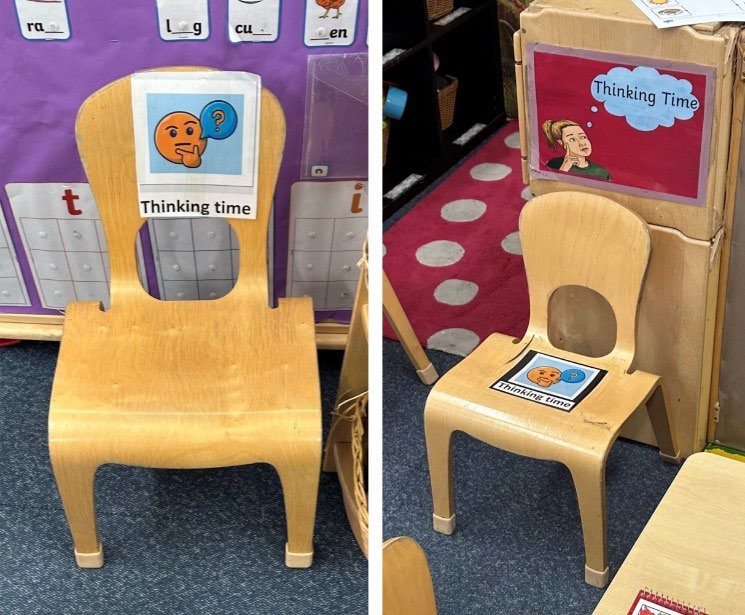
Now I do challenge what “thinking time” really means if it is time where the child is left on their own. And, despite promoting the concept of being an “Emotionally Available School” with all of my staff, I do still have a couple who, even in adulthood, really do not recognise that their selfish actions have consequences for others. So, as far as I am concerned, what being sat on a chair for “thinking time” means to any child or young person is questionable, let alone to a four year old.
And then we have to ask ourselves if the child is actually thinking about what you want them to think about whilst they are sat on those chairs?
I doubt it…
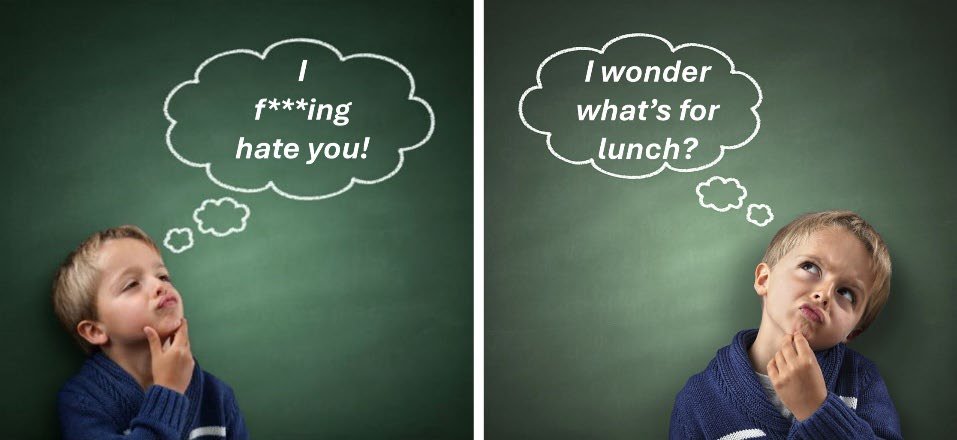
When something goes wrong behaviourally it becomes a learning opportunity and it is the informed conversation between the child and the adult that is the valuable bit. Let’s call it “supported thinking time”. But “thinking time” in isolation is not going to resolve the behaviour challenge for the child any more than leaving them to work out an academic concept, i.e. we wouldn’t tolerate:
Child: “I don’t understand how to do this long division.”
Teacher: “Go and sit on that chair on your own until you have worked it out for yourself.”
So why would we think it would work when dealing with a child’s social and emotional needs?
Now, because we all know that unacceptable behaviour is not a need in itself but the communication of a need; when things don’t go well for a child behaviourally in a lesson, they frequently are in no place emotionally to immediately address the issue with us. We need to give them the opportunity to calm down, and to give ourselves the opportunity to carry on teaching everyone else, before coming back to them to unpick what has happened.
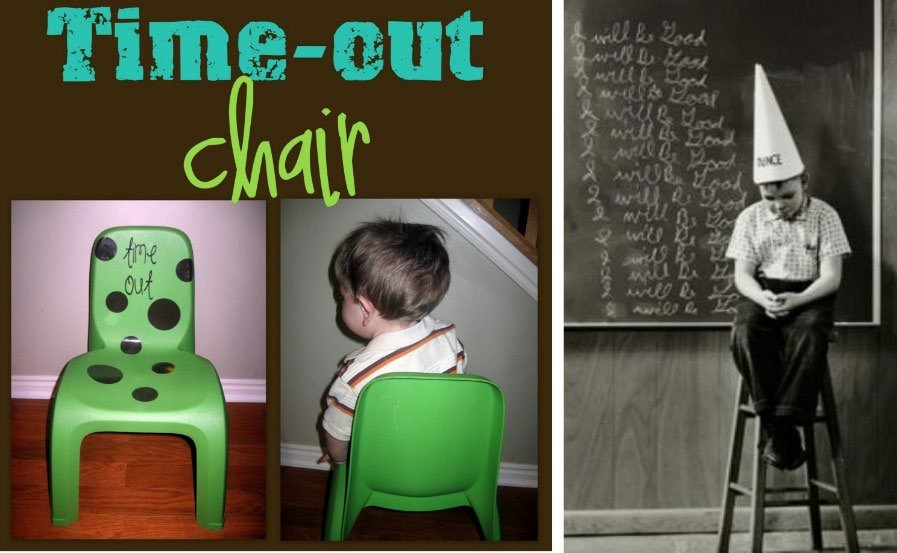
In doing this we need to be doing better than just using a “thinking time/time out chair” which feels a lot like having a “naughty step”, or as I would put it “a very public shaming seat”.
Spot the difference…
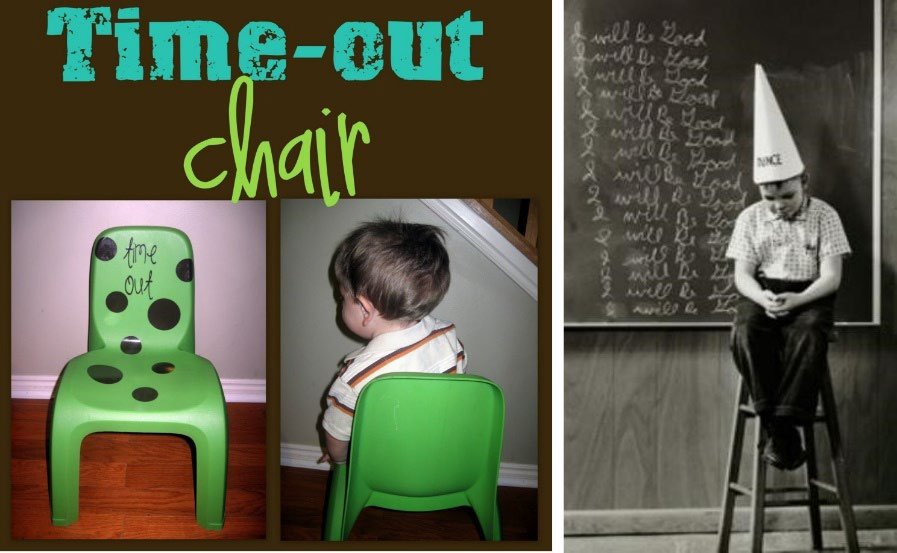
Amazingly, though why am I not all that surprised, you can actually purchase this kind of thing for toddlers…
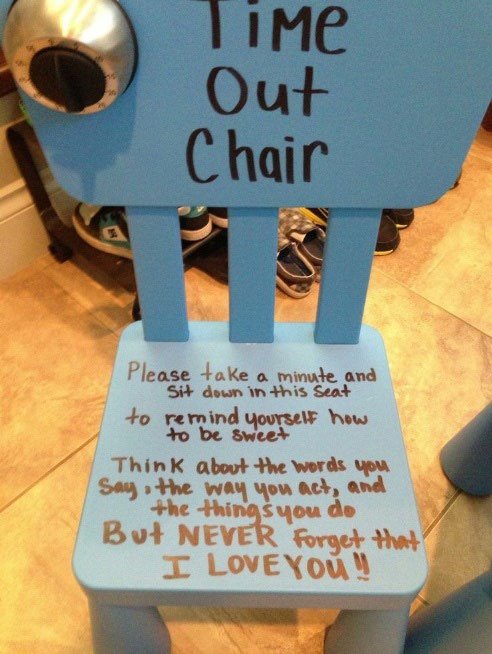
Oh wow! How brilliant! Not only can you put your child somewhere to try and work it out for themselves, you also don’t have to deal with re-engagement, reassurance and restoration. Who knew that you could buy a small piece of furniture that supported Triple P (in this case stands for Particularly Poor Parenting)? Oh Damn! I forgot they can’t actually read yet. I’m going to have to talk to them after all. And I was just settling down for some “me time”.
Do you know what? We can do so much better than that at school because we put the child’s needs before our own needs.
So, at my school, we have now done away with the “thinking time/time out chair” and are creating better de-escalation spaces within our school and calling them something different – maybe “calming corners” but the jury is still out on what they will be named.
The point is that we are properly addressing Trauma Informed Practice in providing safe spaces, both physically and emotionally, in our classrooms;
Create Safety – Find and create a calming space in school where the child can go when signs of distress begin to appear, e.g. corner/cushions/beanbag/pop-up tent/blankets/different room/etc.
Not many classrooms have the luxury of providing a dedicated space but we are looking at using our reading corners as a dual purpose space within a classroom where a child could go to de-escalate – a comfortable space with some screening to de-escalate in, as opposed to a stark chair that places an already distressed child on display in front of their peers.
Of course, that space will need clear explanation to the children and have some ground rules, but it will help to facilitate many of the Low Arousal Approach elements that we are also working on embedding across the school:
- Use a distraction or diversion that creates a space for self-regulation.
- Reduce environmental triggers such as noise, light, temperature etc.
- Remove the audience.
- Know when our presence is escalating stress and tactically withdraw from the situation to give the student time and space to self-regulate.
- Allow adequate time for the student to calm down fully before attempting to talk about the incident.
The following YouTube video will give you some more idea of what I am getting at here. Although based in a setting for older children, it does demonstrate what I am after in supporting vulnerable child both within the classroom and beyond it.
Please do watch it. It is less than 4 minutes: